Atta Junior Owusu
₵150
per visit
Prime: ₵135
Kumasi5(1)
Highly RatedVirtual
Obstetrician gynecologist passionate and dedicated to women’s reproductive health
Next available — tue, Oct 20
Nexplanon is a small, thin rod that a doctor or nurse places just under the skin of your upper arm to help prevent pregnancy for up to 3 years. It is a safe and effective long-term family planning option that you do not have to think about every day. You would visit a clinic to have the rod inserted by a trained health professional in a quick, simple procedure.
Book an evaluation with a healthcare provider immediately if you experience or present with:
When you come in for your Nexplanon insertion, the doctor or nurse will first go over your medical history to make sure the procedure is right for you. They will then clean your upper arm and apply a numbing medicine so you feel little to no pain before gently inserting the small rod just under the skin. The whole procedure is quick, and you will be able to go home the same day.
Our platform supports multiple clinical specialties capable of providing consultations for this visit type:
Clinicians available for nexplanon insertion consultations.
Conditions commonly associated with Nexplanon Insertion consultations:
Sexually transmitted disease (STD)
Also known as: STD, sexually transmitted disease
Vaginal Discharge & STI
₵150
per visit
Prime: ₵135
Obstetrician gynecologist passionate and dedicated to women’s reproductive health
Next available — tue, Oct 20
₵150
per visit
Prime: ₵135
I stay at Achimota Mile 7 , married with 2 kid, completed med school in 2020, currently working at ugmc at Obs and gynae
Next available — mon, Oct 19
₵200
per visit
Prime: ₵180
•Member of Ghana College of Obstetricians and Gynecologists •Member of West Africa College of Obstetricians and Gynecologist
Next available — mon, Oct 19
₵150
per visit
Prime: ₵135
A Senior Specialist Obstetrician & Gynaecologist with a passion for helping women achieve reproductive health and safely deliver their dream babies 👶🏽 Find me on tiktok @TheGynaepreneur!
Next available — mon, Oct 19
₵150
per visit
Prime: ₵135
I’m a medical doctor working in obstetrics and gynecology. My passion is women and all things related to women. Im married with a child for now and currently working at University of Ghana Medical Centre
Next available — tue, Oct 20
The small rod releases a hormone called progestogen slowly into your body. This hormone stops your body from releasing an egg each month, so there is no egg for sperm to fertilise. It also thickens the fluid at the entrance to the womb, making it harder for sperm to get through. When used correctly, it is more than 99% effective at preventing pregnancy.
The doctor or nurse will inject a small amount of numbing medicine into your upper arm before inserting the rod, so you should feel little to no pain during the procedure. You may feel some soreness, bruising, or swelling at the site for a few days afterwards. Taking a mild painkiller like paracetamol can help with any discomfort.
Yes, it is very common for your periods to change after Nexplanon is inserted. Some women have lighter periods or no periods at all, while others may have irregular spotting or longer bleeding. These changes are not harmful, but if the bleeding is very heavy or does not settle after a few months, speak to your doctor.
Nexplanon works for up to 3 years. After 3 years, it must be removed or replaced by a trained health worker. If you change your mind and want to get pregnant sooner, or if you experience side effects, the implant can be removed at any time before the 3 years are up. Your fertility should return quickly after removal.
No, the Nexplanon implant only prevents pregnancy — it does not protect you from STIs such as HIV, gonorrhoea, or chlamydia. To protect yourself from STIs, you should also use a condom every time you have sex. Talk to your doctor if you have any concerns about STIs.
Get connected with local doctors. Instantly schedule appointments for Nexplanon Insertion on our HIPAA-compliant, telehealth-enabled platform.
Our guides are reviewed by internal medical advisory boards to uphold patient guidelines and reference certified therapies.
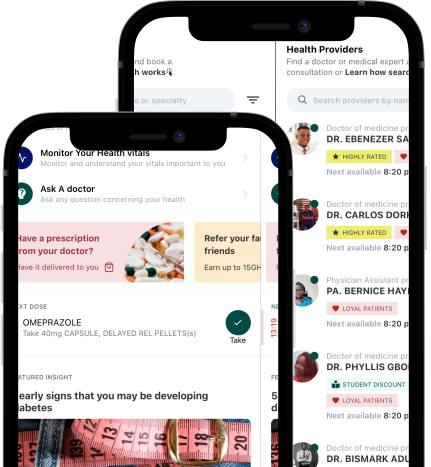
Feeling unwell? Our friendly healthcare professionals are here to listen, advise, and care for you. Just open the app for quick, expert help. No stress, no fuss.